is anyone using the Donor Constituent Code?





Hello all,
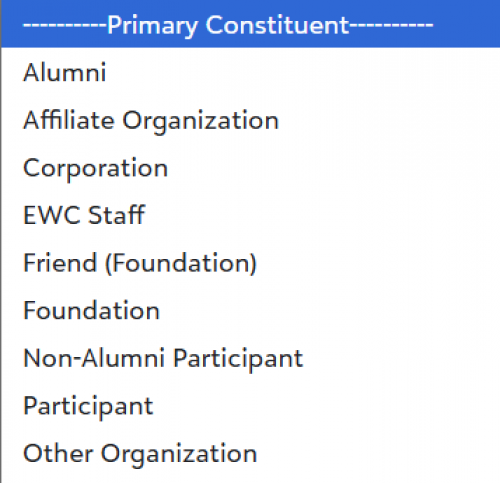
Is anyone using 'Donor' as the constituent code? If yes, how is the code useful when generating queries/reports? As part of data clean up, my organization is considering removing the Donor code from our constituents and sticking with the coding we identified under the Primary Constituent listing (see the screenshot below). When I generate queries/reports, I usually pull donors using the Gifts filter option. I appreciate any feedback your can share.
Comments
-
@Brenda Goo
Not using “Donor” code, not useful.0 -
Hi @Alex Wong - Thanks for the feedback. I totally agree!!
0 -
@Brenda Goo I completely agree with Alex. I don't like to use constituent codes to identify information that changes with some frequency (like Donor, Major Donor, SYBUNT, etc.) especially if that can be queried in some other way.
I have accessed quite a few databases through consulting work, and codes like these are never correct. Donors have no gifts, Prospects do have gifts, Major Donors have not given at a Major Donor Level, there are people giving at a Major Donor level who do not have the code, and so on,
I never recommend that it be used, and typically recommend removing it if it is in use.
Karen
4 -
@Brenda Goo I second what Karen and Alex said. There are other, more useful, ways to determine who a donor is. A simple gift query, or creating an attribute (Custom Field) is much more helpful.
When a field already exists somewhere else, why clutter up your Constituent Codes?
2 -
@Brenda Goo Using any term for a constituent code that deals with giving like Donor, Major Donor, Major Donor Prospect, etc, is completely wrong since that information can be determined by their giving. Plus the fact that someone becomes a “major donor”, who then makes that change in coding. Your constituent coding should be more generalized and something that goes in conjunction with your reporting. Good constituent codes are such terms as Foundation, Corporation, Non-Profit, Alumni, Staff, Board, Former Board, Religious Organization, Parent, School, Government, elected officials,, etc. Depending on your organization and how you like to report on groups of constituents will determine the codes. You also do not want a ton of constituent codes since if you want to break a code down further, attributes are the way to go. My opinion of useless codes are Major Donor Prospect, Major Donor, Individual, Organization, Lawyers, etc. Common codes for all types of organizations would be Board, Former Board, Staff, Former Staff, Foundation, Corporations. An education organization would have those plus Alumni, Parents, Think of what your organization does, who it reaches out to and how you want to report on donations in a general term. An education school would definitely want to know how much money is raised by Alumni and Parents,
2 -
@Brenda Goo Allow me to be the first to say that it might be helpful depending on your organization! Generally speaking, it's not the best constituency, but under the right circumstances it might fit. Having worked in a couple of different verticals, I've seen some cases where the traditional codes don't work for a variety of reasons.
I'd never advocate for using it first, but sometimes you have to do what makes sense.
3 -
@Joe Moretti
This is a great explanation of why codes such as “Donor”, etc. should not be used and your examples of good constituent codes is spot on! However, I still struggle with what code to use for an individual constituent who does not fall into those ...what would you call those constituents? I think that's why so many orgs use “Individual” as a code.2 -
@Madeleine Holdsworth Looking at your list of codes, I would assume ‘Alumni’ is always primary for your alumni.
I will second @Dariel Dixon's comments that it can be helpful for some organizations. My previous experience at a YMCA where I maintained RE for main facility and 2 community branches. For us it worked to have “Donor” as primary code for donors to main facility and “Donor-branch name” for donors to those branches. This was the easiest way to filter lists for each facility without having to try to filter by gift fund. Some constituents supported more than one facility. If we were working with tens or hundreds of records it may not have been practical but with small number of records up dating and maintaining accuracy worked at the time.With the list you shared, I don't see a need for donor. Yes, it can be seen by gift records. Personally, I never saw value in code of ‘Individual’ as that is seen by record type.
0 -
@JoAnn Strommen That one has always been a tough one and I think that would be an exception. Many organizations tend to call that one either Individuals or Friends.
0 -
Hi, @Joe Moretti. That was well said, and I agree entirely. The alumni constituent code is the top or primary for the majority of our constituent records.
0 -
Hello, @Karen Diener. Thank you for the feedback. I am glad other colleagues feel and agree on how constituent codes should be used. I've got a lot of clean-up to do in our constituent code listing and will probably move them to the custom field area.
0 -
@Joe Moretti I agree with your post and the list of codes which is what we mostly use, but we don't currently have Parent and it got me thinking about the best way to ‘connect' the parent to the child on RE. It is easy to do this with spouses in Bio 1 but what would you suggest for parent/child? thanks
1 -
@Lena Payne Parent/Child relationship would have to be connected in the Individual Relationship in the Relationship Tab by linking them.
3 -
@Brenda Goo Depending on the report / query I will use the gift constituent code. Sometimes someone will donate as a student, then they are an alum. If i want to know what constituent code the gift was made under, then I use that. It also happens that a person could be a parent then they become a board member. If I'm looking at the person's history, I generally will use the constituent code tied to the donor. So it really depends on what story you want to tell or report on when you write the query / report.
1 -
@Brenda Goo To each their own… While “Donor” may not seem vey useful to your org or mine, it doesn't mean it's not or cannot be useful to other orgs. I see one or two constituent codes mentioned in this thread that don't seem particularly useful to me initially. This, of course, does not or should not mean they actually are not or could not be useful to me after more thought.
1


























Categories
- All Categories
- 6 Blackbaud Community Help
- 213 bbcon®
- 1.4K Blackbaud Altru®
- 403 Blackbaud Award Management™ and Blackbaud Stewardship Management™
- 1.2K Blackbaud CRM™ and Blackbaud Internet Solutions™
- 15 donorCentrics®
- 360 Blackbaud eTapestry®
- 2.6K Blackbaud Financial Edge NXT®
- 656 Blackbaud Grantmaking™
- 577 Blackbaud Education Management Solutions for Higher Education
- 3.2K Blackbaud Education Management Solutions for K-12 Schools
- 940 Blackbaud Luminate Online® and Blackbaud TeamRaiser®
- 84 JustGiving® from Blackbaud®
- 6.7K Blackbaud Raiser's Edge NXT®
- 3.7K SKY Developer
- 249 ResearchPoint™
- 119 Blackbaud Tuition Management™
- 165 Organizational Best Practices
- 241 Member Lounge (Just for Fun)
- 34 Blackbaud Community Challenges
- 37 PowerUp Challenges
- 3 (Open) PowerUp Challenge: Grid View Batch
- 3 (Closed) PowerUp Challenge: Chat for Blackbaud AI
- 3 (Closed) PowerUp Challenge: Data Health
- 3 (Closed) Raiser's Edge NXT PowerUp Challenge: Product Update Briefing
- 3 (Closed) Raiser's Edge NXT PowerUp Challenge: Standard Reports+
- 3 (Closed) Raiser's Edge NXT PowerUp Challenge: Email Marketing
- 3 (Closed) Raiser's Edge NXT PowerUp Challenge: Gift Management
- 4 (Closed) Raiser's Edge NXT PowerUp Challenge: Event Management
- 3 (Closed) Raiser's Edge NXT PowerUp Challenge: Home Page
- 4 (Closed) Raiser's Edge NXT PowerUp Challenge: Standard Reports
- 4 (Closed) Raiser's Edge NXT PowerUp Challenge: Query
- 796 Community News
- 3K Jobs Board
- 54 Blackbaud SKY® Reporting Announcements
- 47 Blackbaud CRM Higher Ed Product Advisory Group (HE PAG)
- 19 Blackbaud CRM Product Advisory Group (BBCRM PAG)