Prospect Classification field





Hi all,
For organizations who use the Prospect tab in Raiser's Edge and use the Prospect Classification field, I'm curious to know how you are using it. Is it helpful? Does your setup require updating data on some regular basis?
I've never seen it used effectively, and often dismiss it myself, so am making sure I am not overlooking something.
Karen
Comments
-
@Karen Diener I've seen it used to determine what type of prospect the constituent is. For instance, annual vs. major gift. Or even planned gift. I'm not 100% certain, but can a constituent have multiple statuses with different classifications?
0 -
@Karen Diener
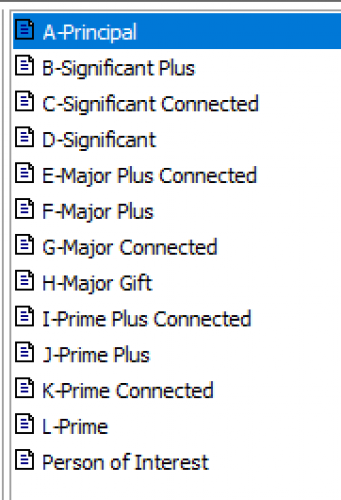
I laughed when I read your post. We have so many old classifications/ratings/catgories/codes and I don't think most staff know what to use.This is what we do have and they are used on records. Rarely work with the prospect side so don't have much to tell you nor can I define these. LOL Users have to have a plan, definitions and commitment to update and use to make any table of entries worthwhile, IMO.
 0
0 -
@Karen Diener I've seen it used to determine what type of prospect the constituent is. For instance, annual vs. major gift. Or even planned gift. I'm not 100% certain, but can a constituent have multiple statuses with different classifications?
That's what I typically see too, but I am always wondering if it is used to pull mailings, or do some other reporting? Does anyone review it once a Major Gift donor is no longer giving at that level? If the Classification contains Major Gift Prospect, is it reviewed once the person is disqualified? I've seen Planned Giving Commitment in there too, but that person could easily have another classification like Major Gift.
I think I'm trying to find a reason to use it. Clients ask about it a lot and want to slap something in the table without giving a lot of thought to it. I remind people that you do not need to use every field that is available. I'll have to see if I can find a good use for it!
Karen
0 -
@Karen Diener
I laughed when I read your post. We have so many old classifications/ratings/catgories/codes and I don't think most staff know what to use.This is what we do have and they are used on records. Rarely work with the prospect side so don't have much to tell you nor can I define these. LOL Users have to have a plan, definitions and commitment to update and use to make any table of entries worthwhile, IMO.
These are interesting! I'd ask more questions but you already said you don't work with the Prospect side. I'm curious if “Person of Interest” could actually be a Prospect Status of Identified or something along those lines.
I completely agree with you that there needs to be a plan, definitions, and commitment to update! That is where most of RE falls apart anyway, right? :-) Any database, to be fair - this field is in no way unique to RE.
My response to Dariel contains just the tip of the iceberg when it comes to my questions. For instance, all of the entries that begin with “Major” - are those reviewed and updated when someone is no longer at a Major Gift Level? Every time I've seen any sort of “Major Gift” information hard coded (a constituent code seems most common) it is never aligned with what the constituent is actually giving.I'm failing to find strategic use for this field, even after 20+ years of using RE and working with many organizations. Will keep pursuing!
Thanks for your feedback!
Karen
0 -
That's what I typically see too, but I am always wondering if it is used to pull mailings, or do some other reporting? Does anyone review it once a Major Gift donor is no longer giving at that level? If the Classification contains Major Gift Prospect, is it reviewed once the person is disqualified? I've seen Planned Giving Commitment in there too, but that person could easily have another classification like Major Gift.
I think I'm trying to find a reason to use it. Clients ask about it a lot and want to slap something in the table without giving a lot of thought to it. I remind people that you do not need to use every field that is available. I'll have to see if I can find a good use for it!
Karen
It's supposed to be reviewed and the status changed. If the person is disqualified, the status changes but the codes stay on the record for historical purposes. I think that is best. Obviously that depends on how on good your fundraisers are at updating things in the database. This panel is used for moves management, and may not reflect current giving levels.
I think it has a lot of potential, but I don't know if many organizations have the patience to roll it out effectively. It takes a lot of planning, and also a whole lot of input to work in the way you would like.
2 -
@Karen Diener We tend to use Opportunities to track where a prospect is in the “ask” continuum, in part because I have always found it hard to get my fundraising team to keep two areas updated so I prioritize Opportunities for the fundraisers to use.
I do use Status and Classification quite a bit, but mostly just to manage our Prospect Pool from a research and mailing management perspective. So Classification is the type of prospect - “Prospect - General” for folks of interest, and then buckets for evaluated people such as Annual Giving, Events, Midlevel, Assigned, and Disqualified. We use these lists for mailings and prioritizing research. The Status is where they are within that type if they are not Assigned to a Solicitor yet. For example, Identified, Qualified, Submitted for Review, Released etc.
Works for us, but certainly not a fit for all teams. We are a small shop and I am the only person doing database management and portfolio management. I use the Class and Status to have a number of pre-built lists in NXT that make it easy to skim and look for prospects of interest.
1 -
@Karen Diener We do use both Status and Classification. Gift officers are required to review their portfolio at least annually and modify those codes as necessary. It is helpful to know if someone has a Classification of Principal Giving, Major Giving, Annual Giving, or Planned Giving. Not a Major Gift Prospect is used when we've determined they are not interested in giving. If someone is coded as Principal Giving the gift officer is required to have a Prospect Strategy Note on file to outline their strategy with that prospect. Same is true for Planned Giving prospects - they have a Planned Giving Strategy Note. Status is used to note the moves management cycle with additional delineation around timing of solicitation - this year vs. next year. Proposal Status is used to speak to the ask itself - Open, Pending, Funded, Declined, Withdrawn
2 -
@Karen Diener We do use both Status and Classification. Gift officers are required to review their portfolio at least annually and modify those codes as necessary. It is helpful to know if someone has a Classification of Principal Giving, Major Giving, Annual Giving, or Planned Giving. Not a Major Gift Prospect is used when we've determined they are not interested in giving. If someone is coded as Principal Giving the gift officer is required to have a Prospect Strategy Note on file to outline their strategy with that prospect. Same is true for Planned Giving prospects - they have a Planned Giving Strategy Note. Status is used to note the moves management cycle with additional delineation around timing of solicitation - this year vs. next year. Proposal Status is used to speak to the ask itself - Open, Pending, Funded, Declined, Withdrawn
I'm curious about the use of Planned Giving. I've seen it a lot, but it nearly always overlaps with Major Giving or another level. Which do you use when someone could be Classified as both? And does “Planned Giving” mean that they have confirmed you're in their estate plans, or you're still working on that?
Thanks for the feedback!
karen
1 -
@Karen Diener Hi Karen,
We've been working with DonorSearch and they've helped us identify prospects that have a high likelihood of being planned giving donors. I also have a method for looking at those people who have been giving smaller gifts but over a period of many years that have proven to be good planned giving prospects. Rather than code them as annual donor or major gift donor we use Planned Giving to indicate this type of gift may be our best option with that prospect. Once we have a planned gift commitment we use an attribute to show they are a member of our Legacy Society- Guardian Circle.
1













Categories
- All Categories
- New YourCause Community TEST
- New SKY Community TEST
- New Grantmaking TEST Community
- New Altru Test Community
- New bbcon Community - TEST
- 12 Blackbaud Agents for Good™
- New Raiser's Edge NXT Community
- 7 Blackbaud Community Help
- 219 bbcon®
- 1.4K Blackbaud Altru®
- 409 Blackbaud Award Management™ and Blackbaud Stewardship Management™
- 1.2K Blackbaud CRM™ and Blackbaud Internet Solutions™
- 16 donorCentrics®
- 361 Blackbaud eTapestry®
- 2.7K Blackbaud Financial Edge NXT®
- 681 Blackbaud Grantmaking™
- 599 Blackbaud Education Management Solutions for Higher Education
- 3.3K Blackbaud Education Management Solutions for K-12 Schools
- 952 Blackbaud Luminate Online® and Blackbaud TeamRaiser®
- 85 JustGiving® from Blackbaud®
- 7K Blackbaud Raiser's Edge NXT®
- 3.9K SKY Developer
- 257 ResearchPoint™
- 123 Blackbaud Tuition Management™
- 165 Organizational Best Practices
- 247 Member Lounge (Just for Fun)
- 40 Blackbaud Community Challenges
- 37 PowerUp Challenges
- 3 (Closed) PowerUp Challenge: Grid View Batch
- 3 (Closed) PowerUp Challenge: Chat for Blackbaud AI
- 3 (Closed) PowerUp Challenge: Data Health
- 3 (Closed) Raiser's Edge NXT PowerUp Challenge: Product Update Briefing
- 3 (Closed) Raiser's Edge NXT PowerUp Challenge: Standard Reports+
- 3 (Closed) Raiser's Edge NXT PowerUp Challenge: Email Marketing
- 3 (Closed) Raiser's Edge NXT PowerUp Challenge: Gift Management
- 4 (Closed) Raiser's Edge NXT PowerUp Challenge: Event Management
- 3 (Closed) Raiser's Edge NXT PowerUp Challenge: Home Page
- 4 (Closed) Raiser's Edge NXT PowerUp Challenge: Standard Reports
- 4 (Closed) Raiser's Edge NXT PowerUp Challenge: Query
- 822 Community News
- 3.1K Jobs Board
- 57 Blackbaud SKY® Reporting Announcements
- 47 Blackbaud CRM Higher Ed Product Advisory Group (HE PAG)
- 19 Blackbaud CRM Product Advisory Group (BBCRM PAG)