Need help regarding constituent code




Hi, is there anyone who can help me point out an idea please regarding constituent code? The more I learned about this, I think the constituent code, based on the example that I can find is more like volunteer, board members, etc...
How about Monthly donors, Major donors, Mass donors, and Regular donors, Where do these categories fall into? I've been trying to google and find solutions to this. Example If I want to label a constituent with one or two of this code.
Thank you.
Comments
-
@Junita Sutirto
we have 25 chapters (offices location), and that is our constituent code (i.e. New York, Long Island, Ohio, Los Angeles, Miami, etc), which is the primary code. (first line)we also have other codes (i.e. National Board Member, Local Board, Advisory Board, Staff, Estate, Foundation, etc)
Do not use constituent code for giving related info (i.e. Major donor, monthly donor, etc), here's a good post that talks about this:
4 -
@Junita Sutirto welcome to Community!
You will find many outlooks on constituent codes. Part of it depends on your industry and how you plan to use the information. When I was at an all girls high school, we had several (really too many): Alumnae, Parent (Current and Past), Faculty/Staff (Current and Past), Board Member/Committee, Organization, Foundation, Scholarship Benefactor, etc. I am now in a hospital and they are much simpler:
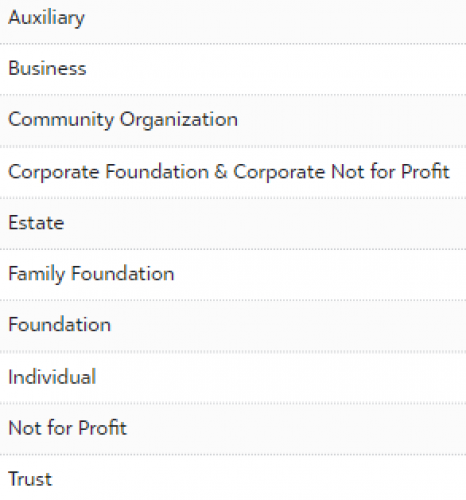
The vast majority of our constituents fall under Individual. We track various ways they're connected to our org via Attributes/Custom Fields. As Alex mentioned, codes related to giving are not typically the best as this can fluctuate and definitely change over time.
While not specific to Constituent Codes, being new to fundraising and NXT in 2020 I found a wealth of help in Bill Connor's book, Fundraising with The Raiser's Edge. He also has some resources on various topics on his web site, including a section specific to constituent codes.
1 -
@Junita Sutirto Constituent codes should not be anything that relates to money such as monthly donors, major donors, etc. All of that information can be found out through the giviing history. Constituents codes are going to be different from organization to organization but they should be general and how you relate to these people or why they are in the database so such things as Staff, Board Member, Former Board Member, Parent, Alumni, Corporation, Foundation, Non-Profit, Volunteer, Student. Anything pertaining to money like Montly Donor or Major Donor is a really bad idea, because these type of things change all the time and who wants to constantly keep updating these codes, when you can find that information by the giving history. Most organization will also want to report on such thing as Board Giving or Alumni Giving, etc and this info can be pulled easily by the constituent codes of Board or Alumni.
2 -
Thank you so much everyone for all the resources. How do I find more information regarding the donor-giving level? My supervisor wants to label or tag a few people based on the relationships in the past like Major donors, mass donors. for ex: mailing or targeted events.
Should I create a label under attribute category > constituent?
Thank you so much.
0 -
@Alex Wong If I need to label few people with giving-related info (i.e Major donor, monthly donor, etc) where can I find out more information about that? Thank youuu.
0 -
@Miki Martin Thank you so much! I've been slowly learning NXT for 2 months, it is really vast and broad but exciting at the same time. ?
1 -
@Junita Sutirto
If you read the post I replied with, you saw the pro and con of tagging vs not tagging based on giving level. So i'm not going to dissaude you if you do decide to do so.IF you are going to tag, don't use constituent code, use a constituent attribute (custom field in webview terminology).
however, if all you want to do is being able to get a mailing list, email list, etc for “major” donor, then define what that major donor is (i.e. donor who gave $10K and up in any one of the last 10 years) and create a constituent query to target these donors.
2 -
@Alex Wong Thank you so muchh for your help. I have lots to read before cleaning up the data
 0
0 -
@Junita Sutirto you can also create levels under Donor Categories. This is a table and there are multiple options you can set. At the moment, none of this will come out in NXT, but you will be able to run reports to see how many you have in each category. They are put in by the minimum amount they have given and go up to whatever the next category is.
That won't help with the recurring donors, but those can be handled using what @Alex Wong mentioned and Custom Fields/Attributes.
0 -
@Lee Grisham Thank you so much!! yes, I've been reading more regarding the attribute and constituent code
0 -
@Alex Wong I read in the article that if possible, each constituent should have a code. For a constituent that does not fall under board member, volunteer, etc, what do you call that? is it just Donor or an Individual?
Thank you.
0 -
@Junita Sutirto There may be an exception but I believe that constituent code is a required field for any org I'm aware of. It tells you why that record is in the database and is the most used filter when querying records.
If not board, volunteer or your other key codes, you will want to create a list of codes to use. Yes, some orgs do use ‘donor’ or ‘individual’ but those things are easily found by query/looking at records. The database I inherited had a code of ‘miscellaneous.' It's one of my clean up projects (still have some very old records to fix) to change them to more accurate code. We use ‘friend…' for those general individual donors.If you search the forum for the topic of constituent codes you'll find some posts where folks have shared their codes.
1 -
@Junita Sutirto At our organization, we do have some situations where the constituent does not really fall into any of our pre-existing constituent codes. For example, they may be some kind of representative for an organization (a lot of our clients are churches, so we frequently have their pastors, treasurers, etc. as constituents in on database as well). The constituent might also be someone we're pursuing for participation in some type of program, but they are not a participant just yet. For constituents who fall into this gray area, we have a constituent code of “Contact.” This is simply used as a filler for the field since it is required. In the future, that field may get replaced with another code (like Donor, Board Member, etc) if the person takes on some other type of role or relationship with our organization.
2 -
Constituent Code does not have to be required, this is a configuration setting for an org to decide.
I do not believe in the “must” use of constituent code just to have one, and never understood the reasoning behind the use of “Individual” constituent code (when I arrived at my org, I saw this code and ask why, and all I got is Blackbaud said so, I removed it completely from our RE).
1 -
@Devan Caton Thank you so much!! all of this discussion and information are really helpful!! I think I know what I have to do now. I also watched the constituent code video regarding the crash course. I started to understand about the pie chart analogy.
1 -
@JoAnn Strommen Yes, I've been reading and researching a lot. I will find out what other org use for their codes ?
0 -
@Alex Wong
Yes, currently our org database is pretty messy. This is going to be long summer project to start organizing and cleaning up 0
0


















Categories
- All Categories
- New K-12 Community Home (TEST)
- New Higher Education Home Page (Test)
- New Impact Edge Community TEST
- New YourCause Community TEST
- New SKY Community TEST
- New Grantmaking TEST Community
- New Altru Test Community
- New bbcon Community - TEST
- 12 Blackbaud Agents for Good™
- New Raiser's Edge NXT Community
- 8 Blackbaud Community Help
- 222 bbcon®
- 1.4K Blackbaud Altru®
- 411 Blackbaud Award Management™ and Blackbaud Stewardship Management™
- 1.2K Blackbaud CRM™ and Blackbaud Internet Solutions™
- 16 donorCentrics®
- 361 Blackbaud eTapestry®
- 2.7K Blackbaud Financial Edge NXT®
- 688 Blackbaud Grantmaking™
- 604 Blackbaud Education Management Solutions for Higher Education
- 3.3K Blackbaud Education Management Solutions for K-12 Schools
- 954 Blackbaud Luminate Online® and Blackbaud TeamRaiser®
- 85 JustGiving® from Blackbaud®
- 7.1K Blackbaud Raiser's Edge NXT®
- 4K SKY Developer
- 258 ResearchPoint™
- 123 Blackbaud Tuition Management™
- 165 Organizational Best Practices
- 249 Member Lounge (Just for Fun)
- 40 Blackbaud Community Challenges
- 37 PowerUp Challenges
- 3 (Closed) PowerUp Challenge: Grid View Batch
- 3 (Closed) PowerUp Challenge: Chat for Blackbaud AI
- 3 (Closed) PowerUp Challenge: Data Health
- 3 (Closed) Raiser's Edge NXT PowerUp Challenge: Product Update Briefing
- 3 (Closed) Raiser's Edge NXT PowerUp Challenge: Standard Reports+
- 3 (Closed) Raiser's Edge NXT PowerUp Challenge: Email Marketing
- 3 (Closed) Raiser's Edge NXT PowerUp Challenge: Gift Management
- 4 (Closed) Raiser's Edge NXT PowerUp Challenge: Event Management
- 3 (Closed) Raiser's Edge NXT PowerUp Challenge: Home Page
- 4 (Closed) Raiser's Edge NXT PowerUp Challenge: Standard Reports
- 4 (Closed) Raiser's Edge NXT PowerUp Challenge: Query
- 829 Community News
- 3.1K Jobs Board
- 57 Blackbaud SKY® Reporting Announcements
- 47 Blackbaud CRM Higher Ed Product Advisory Group (HE PAG)
- 19 Blackbaud CRM Product Advisory Group (BBCRM PAG)