A Better Way to Manage Donor Recognition in Blackbaud Raiser’s Edge NXT®






Recognition Programs help you manage donor recognition over time in Raiser’s Edge NXT. Legacy programs are available now, and lifetime, loyalty, and annual programs are coming next.
By Daisy Alarcon
Recognition Programs are a new capability in Raiser’s Edge NXT, designed to help organizations manage donor recognition as an ongoing stewardship practice. They provide a dedicated, purpose-built space to see who qualifies for a program, understand why they qualify, and cultivate these donor relationships intentionally over time.
This initial release introduces legacy recognition programs, which align especially well with planned giving societies and other recognition efforts based on documented gifts. Over time, we’ll expand Recognition Programs to support additional program types so more organizations can use them across more fundraising scenarios.
A note on availability and what this means for you
Legacy recognition programs are initially available only to customers using the Planned Gift Tracker module. This first program type is designed specifically around planned giving use cases and these organizations will benefit the most from the focused capabilities of this program type.
As we continue to develop lifetime, loyalty, and annual recognition programs, all program types (including legacy programs) will be available to all Raiser’s Edge NXT customers at no incremental cost. Recognition Programs are meant to add value broadly across the solution, and this phased approach allows us to build toward that goal thoughtfully while incorporating customer feedback along the way.
The rest of this post focuses on the questions we’ve heard most often from customers, guidance on when to start now versus when to wait, and what to expect in terms of training and rollout as new program types become available.
What Recognition Programs are (and what they aren’t)
At their core, Recognition Programs are a living space in Raiser’s Edge NXT for managing donor relationships. They’re designed to help you see who qualifies for a program, understand why they qualify, and take intentional action to steward these donors over time.
This also means Recognition Programs are not meant to act like a traditional query or report with dozens of configurable columns. While the setup process may feel familiar if you’re used to building reports, the end goal is different: It’s about ongoing engagement, not exporting a static list.
What’s available now
Today, Recognition Programs support legacy giving programs that honor donors who have made a future gift commitment, such as a bequest or other estate gift. These programs help organizations recognize and steward supporters whose generosity is part of their long-term legacy.
If you are already managing future legacy commitments as gift records in your database using the Planned Gift Tracker module and want a more intentional place to steward those donors, recognition programs are available to you.
A few important things to know:
- Recognition programs are giving-based today. They evaluate qualifying gifts, not actions, opportunities, or constituent codes. You can set rules based on both Constituent and Gift criteria, such as constituent codes and specific gift types, but ultimately, program qualification is driven by a constituent’s giving history.
- You can safely experiment by creating programs in draft or preview state. Once a program is activated, it cannot be deleted or changed to a different program type, so it’s worth taking time to plan before you activate. This is also one of the reasons for the limited release of legacy programs: Early Adopter customers told us the temptation to adapt this useful feature for use with other types of giving programs was strong. We’d prefer to set you up for long-term success using future capabilities that are best suited to these other program types!
What’s coming next (and when)
Recognition Programs are being built and released in phases. After legacy programs, we’re planning support for additional program types, including:
- Lifetime recognition programs: For cumulative giving societies that celebrate donors once they cross a defined lifetime giving milestone. These programs are useful when you want to recognize the full arc of a donor’s generosity over time, not just a single gift or year.
- Loyalty recognition programs: For recognizing sustained support across multiple years. These programs are designed to honor consistency and long-term commitment, whether you define that as consecutive years of giving or total years of participation.
- Annual recognition programs: For year-specific giving societies that reset and renew each year. These programs are ideal when membership is based on what a donor gave during a particular annual cycle, and supporters may requalify year after year.
Our goal is to have the full set of program types available by early 2027. Based on current planning and dependencies, we plan to release lifetime programs in the August-September 2026 timeframe. We expect to release loyalty programs by the end of 2026, and annual programs in early 2027.
Because this is rolling development, timelines can adjust. Releasing in phases lets us gather your feedback as we go, making it easier to adapt and improve before everything is finalized and harder to adjust.
Should you start now or wait?
This is one of the most common questions we have heard. If your organization is prioritizing planned giving recognition today, and you have the Planned Gift Tracker module, starting now could be a smart and rewarding choice. If you’re thinking about annual or loyalty-based memberships, it may be better to take time to plan and wait until those program types are available. Especially if you already have well-established annual cycles in place.
The key thing to remember: Once a recognition program is active, it cannot be deleted. Activating a program “just to try it” and then abandoning it later can create unnecessary clutter that’s tough to manage.
How your feedback shapes what’s next
One of the advantages of building Recognition Programs incrementally is that your feedback can directly influence future development. If you have ideas about criteria, flexibility, or use cases you’d like to see, especially for loyalty or annual programs, we encourage you to submit them to the Idea Bank while those program types are still in active design and development. .
It’s much easier for us to incorporate feedback at this stage than after everything is already locked in.
Training and enablement
This Legacy Recognition Programs micro-learning provides an overview and demo of this new capability. An eLearning course will be released soon. As additional Recognition Program types become available, we will provide training resources to support them.
A final word on expectations
Recognition Programs are designed to enhance your work by strengthening donor relations without disrupting your day-to-day operations. This isn’t a forced change or something that you need to implement immediately. Most organizations will adopt these capabilities over time as they learn what works best for their fundraising goals and overall strategies.
If you choose to start now, start intentionally. If now isn't the right time, that's perfectly fine. Recognition Programs will continue to grow, and we’re excited to build them with you.
Comments
-
This is an exceptionally well-written post. Very thorough and with a lot of clarity around cost, timing, functionality, etc.
I do have a couple of comments (of course) about feedback influencing future development. Since the initial launch is to a small set of customers - i.e., only those with the Planned Gift module - it is very hard for users to test and provide feedback. Planned giving societies are unlike other giving-based societies too, so it seems an odd place to start.
It is also very likely that these customers also already have structures in place to track this information since it was missing for so long. Since this information is not queryable / reportable, I am hard-pressed to see them changing their process. I am working with a customer right now to clean up their Legacy Society coding, and I can't see how this new functionality will help them. If anything, it will result in redundant information in their database which I think will be confusing.2 -
I think this is an exciting new tool to add to the repertoire, and I’m eagerly looking forward to the Lifetime, Annual and Loyalty recognition programs being released in the not-too-distant future. I’ve been tinkering with the previewed version of some Legacy programs and I think this can be really helpful for some upcoming work our organization is hoping to do. While our use of RENXT doesn’t line up perfectly with this tool as designed, I think we can do a lot with these features:
- Easily restrict program to those with a particular constituent code.
- Build program based on a (constituent) query of records.
- This can do a lot of the heavy lifting that the rest of this tool can’t do – yet.
- Easily exclude those who “give anonymously”
- Choose between gift amount and receipted amount for qualifying the gifts
- Add soft credit and matching gift recipients in the program as well.
- Add individuals by hand who don’t qualify the normal ways.
However, while it’s tempting to start using this tool for our diverse (and time-sensitive) needs through homemade workarounds, please heed these words of caution:
“Once a program is activated, it cannot be deleted”.
For this reason, I’ve chosen to wait to see how the other three recognition programs are designed, and do some careful strategizing with our development team before building permanent additions to our database.
And yet, in the meantime I’ve found I can do some good work with this while our recognition programs are still in Preview mode. Before making a recognition program Active, I find that I can:
- Create a qualified list of records that can be turned into a List, or exported.
- See the total number of donors and total amount of gifts that qualify.
- See number and amount of gifts that qualify, and date when they first qualified.
- See which levels each donor qualifies for, based on custom restrictions.
- Filter list by qualified level, total qualified gifts, total qualified giving, and date qualified.
It will help our team start to dream of possibilities at least, and I can gather together data that will help support our organization’s Capital Campaign project while I do my best to wait patiently for more to be released. 😊
5 -
I don't have access this but is there any way you could have it automatically add/update a custom field that notates the program they are in? Then you'd be able to query on it. Sounds cool, but if you can't query on it, I'm still going to have to maintain all the old custom fields that we currently use to track these things.
2 -
Thank you @Daisy Alarcon for this very helpful post!
I think it highlights a few really good points to keep in mind!
First - there's no rush to implement this right away - I know we're all juggling a lot, especially with how much change is happening to core functionality in webview. It is ok to punt this farther down the road until you have more bandwidth. I'm very excited about Recognition and especially about Loyalty Programs, but I know my top priority right now is keeping on top of how core functionality is making the jump from database view to webview. Having said that - it's definitely worth playing with Legacy Recognition if you have the time!
Second - I really encourage folks not to try to put a square peg in a round hole with Legacy Recognition. It is set up for planned giving specifically and while you COULD try to shove a different kind of Recognition program into it, it will never have the features those future Recognition programs would have. Resist the urge to spend a lot of time setting up a work-around and just wait for the other Recognition Programs to be released that are built with the specific needs of those programs in mind (Loyalty, Cumulative, Annual).
Third - Keeping a program in Preview is a great way to play around and get a feel for the functionality before it's written onto records. Even in Preview, you can do a lot! You can see the list of folks who are qualified, and can even export that list. In fact, my team completed a whole stewardship mailing for all of our living donors with a planned gift on file while we were still in Preview! We just exported from the preview list, used that list to create a query and used that query to export the fields we needed for the mailing.
Fourth - I highly encourage everyone to think of Recognition in conversation with your stewardship strategy. These are, at their heart, stewardship tools. And while I am looking forward to being able to query on recognition programs directly (Daisy, this wasn't covered in the post, but I think I remember hearing that Recognition will be in query in the future, right?), a lot of how Recognition built is meant to be worked with inside RE directly (especially after a program is Active and shows up for Fundraisers on Constituent records). As my team started working with Legacy Recognition, we realized we actually needed three Legacy Recognition Programs, vs the single program we thought we needed! To match our strategy, we've set up the following programs: Legacy - Stewardship (list of living legacy donors who we want to steward intentionally and love on); Legacy - Donor Wall (a list of all the legacy donors who need to appear on our public legacy donor wall - i.e. all legacy donors who's legacy gifts are not anonymous); Legacy - Emeritus (legacy donors who have passed and whose planned gifts have been realized). This gives us a really easy way to think about our planned giving donors and work with them.
Fifth - If you're a system admin, its also easy to miss that there are permissions to set up to let your users in on Recognition programs. (It's under Fundraising Roles: Recognition Tasks). I encourage data managers to play around with Recognition Programs in preview to get a feel for how it works, and then be intentional about who else in the organization needs access and at what levels. Do you have a Gift Officer assigned to Planned Giving? They probably need more hands-on access (possibly approve/decline rights for each program). Do you want to encourage your co-workers to work with the lists/programs inside RE webview? Be strategic about who has rights to export recognition lists.
I'm so excited about this new tool for stewardship and cannot wait to get my hands on the other three Recognition Programs, but for now we're taking a slow, steady, and strategic approach to Legacy Recognition.5 -
Hi @Karen Diener, thank you for the thoughtful feedback! I really appreciate you taking the time to share this perspective.
You’re right that planned giving societies aren’t always representative of how other recognition programs are managed, and that many organizations already have established processes in place. That’s something we were very aware of going into this. And you’re also right that starting in a more focused area can limit how broadly this is tested early on.
We chose to start here because it’s a more clearly defined use case where we could build something focused and usable, while creating a foundation we can expand on over time. This initial release isn’t intended to replace existing processes overnight, especially for teams that already have structures working well for them.
And your point around queryability and reporting and is totally fair. We know that making Recognition available in Query will be a key part of making something like this truly usable, and it’s something we’re actively planning for as we continue to build out the capability. For now, we recognize that existing workflows may still be the source of truth for many teams.
Again, I really appreciate the example you shared. That kind of real-world context is exactly what helps us shape what comes next.
2 -
Hi @Tioga Anderson , that is a great idea! Today, you can create a constituent list from a recognition program, and from there, create a query of the constituent list, but the automated path could be very cool. I recommend you post this in the Idea Bank for voting, and I will keep this in mind as we expand functionality in web view (such as global change) and how it could benefit recognition programs. Thank you for your feedback.
1 -
Hi @Maya Rosman, good catch! It's not mentioned in the blog post, but we do have it on our backlog to bring Recognition programs into Query. That's still planned. And thank you so much for this incredibly detailed, thoughtful, and spot-on comment. I really appreciate you taking the time to share how you’re approaching this in practice - and for others who are following along, this is a great model to learn from and try out in Preview when you have the space & time to do so (as I know we're all very busy these days!).
2 -
Thank you for the confirmation, Daisy!
0 -
For all you folks that get excited about some of the new features, like the Recognition Program, have you even tested it out (right now they only have Legacy Recognition). I tested it and while you can choose certain things, including soft credit to Donors or Soft Credit Recipient or Both (which both you would need to choose to capture hard credits from DAVF and the donor), there is no exclusion like attributes, where you can, at least for us, remove a source attribute of Donor Advisor Fund. So you will have a recognition of Legacy for DAVF. And you cannot report off of this or query off of it as well, since Recognition is just a tile in RE NXT to just view. If you choose Donor, you just have the DAVF (the hard credit). If you choose Soft-Credit Recipient (you may get the spouse and not the main person or the employee and not the ORG, So you want to choose Both, but you do not want a DAVF to have the recognition, just the donor who was soft credited.
This needs to be thought out more.
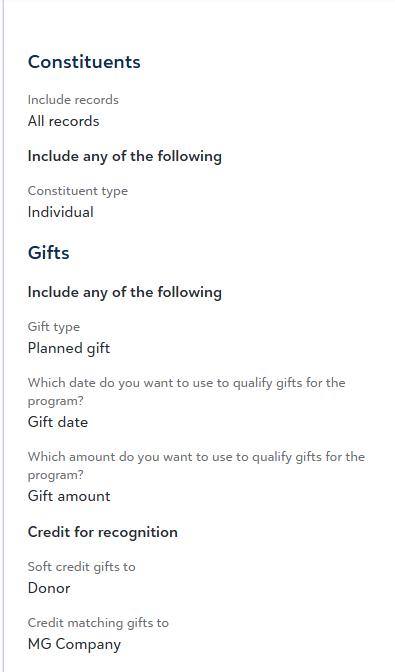
In Database view, you can remove such items like in RE Mail or Query:
RE MAIL:
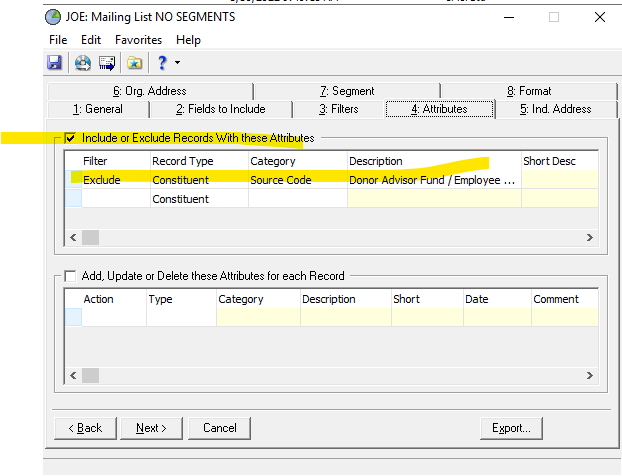
Query:
 0
0 -
Does anyone know when Recognition Programs will be available for all users? Thank you in advance.
0 -
Kia ora everyone.
We're redesigning our regular-giving stewardship journey. We currently trigger communications based on gift count, but we have weekly, fortnightly and monthly donors, so gift-count triggers result in very different communication frequencies. Will the upcoming Loyalty Recognition Programs allow us to define recognition milestones based on number of gifts and/or duration of regular giving, and can those qualification levels be queried or used to create automated email/direct-mail audiences?
0





















Categories
- All Categories
- New Impact Edge Community TEST
- New YourCause Community TEST
- New SKY Community TEST
- New Grantmaking TEST Community
- New Altru Test Community
- New bbcon Community - TEST
- 12 Blackbaud Agents for Good™
- New Raiser's Edge NXT Community
- 8 Blackbaud Community Help
- 221 bbcon®
- 1.4K Blackbaud Altru®
- 410 Blackbaud Award Management™ and Blackbaud Stewardship Management™
- 1.2K Blackbaud CRM™ and Blackbaud Internet Solutions™
- 16 donorCentrics®
- 361 Blackbaud eTapestry®
- 2.7K Blackbaud Financial Edge NXT®
- 686 Blackbaud Grantmaking™
- 603 Blackbaud Education Management Solutions for Higher Education
- 3.3K Blackbaud Education Management Solutions for K-12 Schools
- 953 Blackbaud Luminate Online® and Blackbaud TeamRaiser®
- 85 JustGiving® from Blackbaud®
- 7K Blackbaud Raiser's Edge NXT®
- 4K SKY Developer
- 257 ResearchPoint™
- 123 Blackbaud Tuition Management™
- 165 Organizational Best Practices
- 247 Member Lounge (Just for Fun)
- 40 Blackbaud Community Challenges
- 37 PowerUp Challenges
- 3 (Closed) PowerUp Challenge: Grid View Batch
- 3 (Closed) PowerUp Challenge: Chat for Blackbaud AI
- 3 (Closed) PowerUp Challenge: Data Health
- 3 (Closed) Raiser's Edge NXT PowerUp Challenge: Product Update Briefing
- 3 (Closed) Raiser's Edge NXT PowerUp Challenge: Standard Reports+
- 3 (Closed) Raiser's Edge NXT PowerUp Challenge: Email Marketing
- 3 (Closed) Raiser's Edge NXT PowerUp Challenge: Gift Management
- 4 (Closed) Raiser's Edge NXT PowerUp Challenge: Event Management
- 3 (Closed) Raiser's Edge NXT PowerUp Challenge: Home Page
- 4 (Closed) Raiser's Edge NXT PowerUp Challenge: Standard Reports
- 4 (Closed) Raiser's Edge NXT PowerUp Challenge: Query
- 828 Community News
- 3.1K Jobs Board
- 57 Blackbaud SKY® Reporting Announcements
- 47 Blackbaud CRM Higher Ed Product Advisory Group (HE PAG)
- 19 Blackbaud CRM Product Advisory Group (BBCRM PAG)