Packages in Blackbaud Raiser's Edge NXT®: What They Are, How to Use Them, and What's Coming Next






Behind every appeal is a story about what matters to your organization. Packages reveal the approach you took and the strategies that proved most effective.
Despite being one of the most powerful tools in Raiser's Edge NXT for understanding campaign performance, packages are also one of the most misunderstood. Some organizations use them extensively. Many use them lightly. And most are somewhere in between—tracking packages but not yet using them to learn and strengthen performance.
This post covers what packages are, why they matter, how organizations are using them today, what's new, and where we're headed next.
What are packages and where did the name come from?
The term "package" comes from traditional direct mail fundraising, where each solicitation was literally a different physical package: a different envelope size, a different letter, a different reply card. Each variation was tracked separately so organizations could answer a simple but critical question:
"Which version of our appeal actually drove the best results?"
That question hasn't changed. But packages have evolved far beyond the mailbox.
What packages mean today
In Raiser's Edge NXT, a package represents any version, variation, or test within an appeal. That could be:
- Email A vs. Email B—different subject lines or messaging
- Postcard vs. letter vs. digital ad—different channels
- Segment 1 vs. Segment 2—different audiences
- Year-end vs. spring renewal—different timing within a campaign
- Event follow-up vs. cold outreach—different engagement contexts
Packages give you a structured way to compare these variations—not just track that they happened, but understand which ones drove gifts, donors, and revenue.How packages support the bigger picture.
Understanding how a package fits into an appeal can make their usefulness much clearer. Fundraising in Raiser’s Edge NXT follows a straightforward hierarchy, starting with the broadest goal and narrowing down to the most specific details:
- Campaign: The big picture goal you are working towards (for example, “2026 Annual Fund”).
- Fund: The specific purpose for the funds raised (for example, “General Operating” or “Scholarships”).
- Appeal: How you asked; a specific solicitation or outreach (for example, “Spring 2026 Appeal”).
- Package: A variation within that appeal; a specific version, channel, segment, or test (for example, “Spring 2026–Email A” and “Spring 2026–Direct Mail”).
The key distinction: an appeal is the ask, and a package is a variation of that ask. The appeal answers “how did we ask?” while the package answers “which version led to this gift?” Since appeals can include multiple packages, you gain valuable insights for comparing results and refining your strategy.
Best practice: Think of packages as experiments
The most effective organizations treat packages like a testing framework:
Define what you're testing—channel, creative, audience, timing
Track each variation as a package within the appeal
Compare results—which package drove the most gifts? The highest average? The best ROI?
Apply what you learned to the next appeal
This approach turns every appeal into a learning opportunity, not just a fundraising effort.
How organizations are using packages today.
We looked at package usage across all Raiser’s Edge NXT customers to understand how packages are being used in practice.
The big picture
Most organizations are now using packages but most are just scratching the surface. A smaller group is taking full advantage and running them at scale.
- 75.7% of organizations have incorporated packages into least one appeal.
- However, only 17.6% of appeals include a package—meaning most appeals still don’t use them.
- For appeals that do use packages, the median number of packages is two, and the most common (mode) is one. The average mean is higher, around 11 packages, but that’s because a few organizations are heavy users.
The most segmented appeal in our data includes more than 180,000 package variations. This reflects extensive, multichannel testing over time, often tied to evergreen appeals, which we generally advise against using.
What the range tells us
How packages are used | What it looks like |
|---|---|
Getting started | A few packages per year, typically one variation per appeal |
Building a testing habit | Multiple packages per appeal—comparing channels or creative |
Running experiments at scale | Systematic variation tracking across appeals, segments, and channels |
Advanced campaign intelligence | Thousands of packages over time, with cost tracking and performance analysis |
The opportunity
The data reveals a clear trend: organizations that use packages extensively gain more value by treating them as a decision-making tool, rather than a simple tracking field. They compare, learn, and refine their approach, appeal after appeal, year after year.
If your organization uses packages lightly or has yet to start, now is the perfect time. Managing them and viewing them is simpler than ever.
Here's what that looks like in practice:
- Focus on what works. An organization runs three packages within a year-end appeal—direct mail, email, and a social media campaign. After reviewing results, they find that email consistently delivers the highest average gift at the lowest cost. The next year, they allocate more of their budget to email and test two new variations within that channel—refining based on evidence rather than guessing.
- Cut what doesn't work. Another organization has been sending out a postcard package for years simply because that’s how they have always done it. When they compare its performance to other packages in the same appeal, they discover it generates the fewest gifts and the lowest ROI. They retire the postcard, reinvest in the stronger channels, and see better results overall.
- Test with purpose. A team isn't sure if major gift prospects respond better to a personal letter from the executive director or a general organizational appeal. They create two packages, track the outcomes, and let the data answer the question.
The common thread? Packages turn opinions into evidence. By focusing on what works and letting data drive decisions, you can plan smarter and achieve stronger results.
We want to hear from you. How does your organization use packages to make decisions? Have you discovered something surprising by comparing package performance? Share your insights below. Your experience could inspire another organization to get started.
Available now: the packages list on the appeal record

Before you can analyze package performance, you need a clear view of what you're working with. That’s why the appeal record now includes a dedicated packages tab—available to everyone today—giving you a clear, organized view of all the packages associated with your appeal.
With the Packages tab, you can:
- See all packages associated with an appeal in one place, with key details visible at a glance.
- View package descriptions, goals, total raised and recipient counts without leaving the appeal record in the web view.
- Understand how packages relate to gifts, donors, and overall appeal performance.
The Packages tab works alongside the other appeal tabs—Overview, Gifts, Donors, and Analysis—so you can move between strategy and results without switching tools. It's designed to help you see what's happening within an appeal, not just what happened overall.
Already managing packages in database view? Every package created in database view appears in the web view Packages tab, where you can view and edit them—no extra setup or migration needed.
What's new: managing packages directly in Raiser’s Edge NXT web viewYou can now fully manage your appeal variations without leaving the web view experience.
- Add packages. Create new packages directly within an appeal. Capture key details like description, channel, dates, and cost, right where you're already working.
- Edit package details. Update descriptions, costs, dates, and other attributes as campaigns evolve. Keep your data current without switching experiences.
- Remove packages. Clean up test, duplicate, or outdated packages to maintain data quality. (Packages can only be removed when no gifts, expenses, or constituent appeal records reference them.)
Why this matters: Managing packages in web view lets your team set up, adjust, and maintain appeal variations in the same place you review results, reducing friction and keeping data clean.
Premium preview: package performance on the Analysis tab
As organizations expand their use of packages, the next question becomes inevitable:
"Which of these packages delivered the best results and which fell short?"
We're introducing a package performance experience on the Appeal record's Analysis tab, built to give clear answers to customers with access to Premium features.

The package performance view compares your top-performing and lowest-performing packages side by side across key fundraising metrics. It helps you quickly spot success and areas needing improvement without digging through reports or exporting data.
Premium metrics you'll see
Premium metric | What it tells you |
|---|---|
Total revenue | Which package brought in the most (or least) total giving |
Number of gifts | Which package generated the most donor responses |
Median gift | The typical gift size for each package |
Average gift | The mean gift amount across each package |
Largest gift | The highest single contribution per package |
Donor count | How many unique donors responded to each package |
ROI | Return on investment when package cost is tracked |
Conversion rate | Percentage of solicited constituents who gave (when solicitation data is available) |
This premium experience is especially useful when you need to:
- Evaluate which solicitation approach drove the strongest results
- Identify underperforming packages before planning your next appeal
- Justify budget allocation based on actual ROI
- Report to leadership on what's working with real numbers
We will continue to invest in packages for all customers as a core part of the Raiser’s Edge NXT fundraising experience. Expect these upcoming enhancements
- Managing benefits tied to packages. You'll be able to create, update, and manage benefits connected to individual packages—keeping fulfillment aligned with your campaign setup and removing the gap between how you plan and how you deliver.
- Smarter tools for interpreting package performance.We're exploring ways to help you go beyond the numbers and understand why a package performed the way it did. Future capabilities will focus on:
- Helping you interpret performance patterns across packages
- Surfacing insights you might not spot on your own
- Guiding next-best actions based on what the data shows
The goal: move from tracking what happened →understanding why→knowing what to do next—without needing to be a data analyst.
Three ways to get more from packages todayWhether you're just starting or already using packages, these practices will help you get more value:
- Use packages intentionally for testing. Don't create them just to track data. Define what you're comparing—channel, creative, audience, timing—and structure your packages to answer a specific question.
- Track cost when you can. Adding cost to your packages unlocks ROI analysis. Even rough estimates are better than nothing because they let you see which variations are worth the investment.
- Review performance at the package level, not just the appeal level. Appeal-level results show you the total. Package-level results reveal what contributed to the total and that's where real learning happens.
Learn more about packages
Learn more about the new Package tab on the Appeal record in Help documentation.
The bottom line
Packages started as a way to track different envelopes in the mail. Today, they're how you test ideas, compare strategies, and learn what works.
With the packages list available now on every appeal record, full management in web view, a new performance view on the way, and smarter tools ahead, packages are a practical way to improve your fundraising efforts, one appeal at a time.
Comments
-
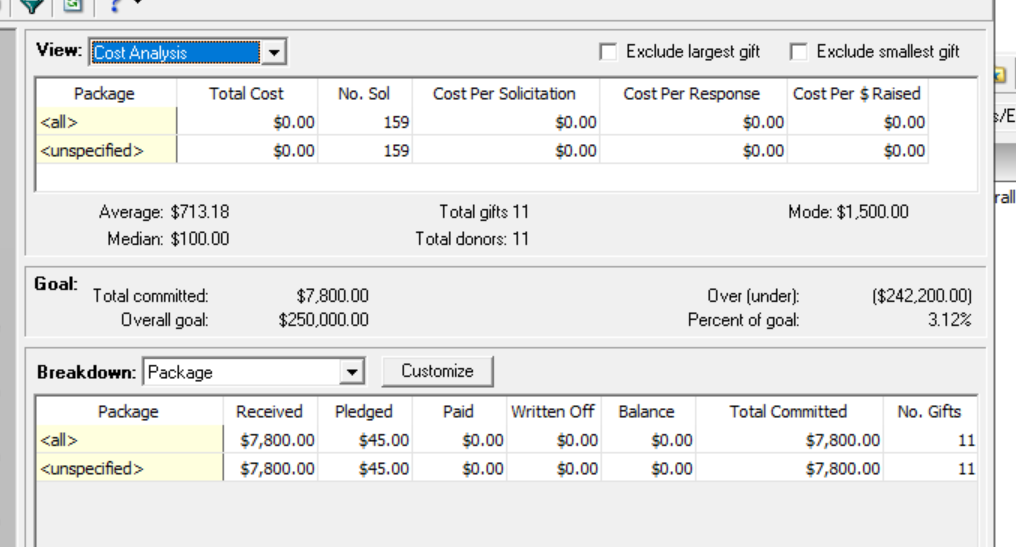
Great article, Heather — I would love to see more of these types of articles. I'm disappointed to read this Package analysis is going to be just for Premium customers when so few are. However, at this point there is no Package reporting at all in the Appeal. Can all customers except an Overview or Analysis tile in the Appeal that shows at least the basic performance of each Package, such as # gifts, dollars, performance against goal, etc.? This isn't the best example of sample data, but we have it in the database view now for all users and have nothing comparable yet in the web view (notice the columns for package in both grids):
 6
6 -
@Heather McLean Can you explain the design intent of having a Package Tile that appears on the Details tab and there is no Packages tab, you enter one or more packages on the Packages tile and THEN a Packages tab show ups, and the tile and the tab then just duplicate functionality after that? This seems like unusual behavior — is it intentional? Thanks.
FYI that this makes your link to the Help file confusing because it talks about a Packages tab which doesn't exist until a package is added to the Packages tile on the Details tab.
1 -
@Bill Connors -
Thank you so much for the kind words, and for this thoughtful feedback — this is exactly the kind of conversation I was hoping to spark.You're right that the database view has had Package columns in those grids for a while, and I completely understand the frustration with the gap in the web experience. Here's some good news on that front: all customers will see the following Package columns in the Package list next week:
- Cost
- Total revenue
- Gift count
- Donors count
- Largest gift
That covers the core "how did each Package perform?" question you're describing — gifts, dollars, and enough context to evaluate basic package performance directly in the web view.
The additional analytical columns — average gift, median gift, ROI, and conversion rate — will be part of the premium features. The thinking behind that split is that those metrics move from reporting what happened into helping teams decide what to do next: whether this package was worth the cost, how it benchmarks, where to invest next cycle. That decision-support layer is where we've focused the premium feature set.
On the goal performance view (over/under, percent of goal) — we're introducing a new goal system across the board, and Package-level goal analysis is something we'll be building on top of that foundation in coming releases. Stay tuned for more on that.
3 -
@Heather McLean , terrific, thanks! And thoughts on the unusual interplay between the Packages tile and Packages tab? Thanks again!
1 -
@Bill Connors -
Great question — the behavior is intentional, and here's the design logic behind it:The Packages tile on the Details tab is where you get started — it's your starting point for adding packages to an appeal record. Once you have at least one package, the Packages tab appears, giving you a dedicated list view where you can also analyze, add, edit, or remove packages. We intentionally hide the tab until there's something there — an empty Packages tab on every appeal would just be noise for customers who don't use packages.
If you have access to premium features, there's also a separate Packages tile on the Analysis tab with comparative performance metrics.
On the help file — if you look at the Appeal Records topic, the Packages link in the navigation actually includes the note "(Only appears when at least one package exists)", so it does document the conditional behavior. That said, I can see how landing on the help article before adding a package and seeing a tab referenced that isn't there yet could be disorienting. We're always looking to make our help content clearer — if anything feels confusing, please use the feedback option on the help page and let us know.
4 -
I have long been a fan of using packages, primarily because of the great reporting it shows on the Appeals Analysis. Whenever I show that to customers, their eyes light up and they gasp. This is exactly what they want to see.
How utterly disappointing that packages are finally getting the attention they deserve, but only for customers who are able to afford to pay for premium features. I would argue that the customers who need this the most - relatively simple yet strategic tracking systems - are exactly the ones who cannot afford it.4 -
@Karen Diener — you've been championing packages longer than most, and that reaction you describe — eyes lighting up, the gasp — is exactly what we were building toward. I don't want to dismiss what you're feeling here, so let me be precise about what's behind this decision.
Everything that answers "what happened with each package" is available to all customers. The columns landing for everyone next week — total revenue, gift count, donor count, largest gift — cover the core performance question you've been showing clients for years. That's not gated.
What is premium is the layer that answers "was this worth it, and what should I do differently next time" — ROI when cost is tracked, conversion rate, average and median gift as benchmarking tools. That line isn't arbitrary. We grounded it in how customers actually use packages. Organizations on the Complete tier use packages at roughly three times the volume of others and run nearly twice as many variations per appeal at peak. The decision-support metrics are designed for that level of deliberate, iterative testing — they only become meaningful at a certain depth of usage.
In database view, we couldn't make that distinction. Everyone got the same experience regardless of how they actually worked, which meant the interface either overwhelmed lighter users or fell short for sophisticated ones. Web view gives us the flexibility to meet customers at their actual level — and that's what we're doing here. Simpler users get a clean, usable experience. Power users get the full analytical toolkit they'll actually put to work.
That's the intent: not to monetize a feature, but to match the experience to the need.
2 -
We use packages extensively and I'm really hoping that custom fields for packages are coming - the idea bank idea says "Shipped" and I'm hoping that really does mean packages and there's not been a misunderstanding that this was for appeals!
One of the things we use packages for is to track giving in celebration of birthdays, wedding anniversaries and other happy occasions and custom fields/attributes on packages was a GAME CHANGER when it came to attempting to put together the Celebrations page for our twice yearly magazine - no more attempting to parse a package description and then manually correct dozens and dozens of names, just every week check that the attribute for how our celebrant is to be listed is filled out! The custom fields on package has been even more useful since another organisation merged with ours because we've also added one to help us discern which organisation the celebrant belongs to so that we can appropriately recognise them in our magazine. It turned what was days of work into a couple of hours at most!
Of course - we use them to track seasonal appeal segments and the different kinds of event income, but making the most of them for these celebrations has been so good and seeing the numbering go up as we create a package per celebration is always heart-warming because it means so many people are supporting us during these milestones in their lives. 🥰
1 -
I can appreciate that. But I know organizations who have relied heavily on packages that may not be able - or willing - to pay extra for a premium version. They could probably make a better decision if they knew pricing, which is still not transparent.
It is like the old days of cable TV - in order to get HBO, you had to buy a package that included HBO but the price was inflated by all of the other channels you never watched. You just want one thing but need to pay for surplus that you'll never use.3










Categories
- All Categories
- New YourCause Community TEST
- New SKY Community TEST
- New Grantmaking TEST Community
- New Altru Test Community
- New bbcon Community - TEST
- 12 Blackbaud Agents for Good™
- New Raiser's Edge NXT Community
- 7 Blackbaud Community Help
- 218 bbcon®
- 1.4K Blackbaud Altru®
- 409 Blackbaud Award Management™ and Blackbaud Stewardship Management™
- 1.2K Blackbaud CRM™ and Blackbaud Internet Solutions™
- 16 donorCentrics®
- 361 Blackbaud eTapestry®
- 2.7K Blackbaud Financial Edge NXT®
- 680 Blackbaud Grantmaking™
- 598 Blackbaud Education Management Solutions for Higher Education
- 3.3K Blackbaud Education Management Solutions for K-12 Schools
- 952 Blackbaud Luminate Online® and Blackbaud TeamRaiser®
- 85 JustGiving® from Blackbaud®
- 7K Blackbaud Raiser's Edge NXT®
- 3.9K SKY Developer
- 257 ResearchPoint™
- 123 Blackbaud Tuition Management™
- 165 Organizational Best Practices
- 247 Member Lounge (Just for Fun)
- 40 Blackbaud Community Challenges
- 37 PowerUp Challenges
- 3 (Closed) PowerUp Challenge: Grid View Batch
- 3 (Closed) PowerUp Challenge: Chat for Blackbaud AI
- 3 (Closed) PowerUp Challenge: Data Health
- 3 (Closed) Raiser's Edge NXT PowerUp Challenge: Product Update Briefing
- 3 (Closed) Raiser's Edge NXT PowerUp Challenge: Standard Reports+
- 3 (Closed) Raiser's Edge NXT PowerUp Challenge: Email Marketing
- 3 (Closed) Raiser's Edge NXT PowerUp Challenge: Gift Management
- 4 (Closed) Raiser's Edge NXT PowerUp Challenge: Event Management
- 3 (Closed) Raiser's Edge NXT PowerUp Challenge: Home Page
- 4 (Closed) Raiser's Edge NXT PowerUp Challenge: Standard Reports
- 4 (Closed) Raiser's Edge NXT PowerUp Challenge: Query
- 822 Community News
- 3.1K Jobs Board
- 57 Blackbaud SKY® Reporting Announcements
- 47 Blackbaud CRM Higher Ed Product Advisory Group (HE PAG)
- 19 Blackbaud CRM Product Advisory Group (BBCRM PAG)