CVV number on a remit envelope




Is an organization located in the US allowed to require the CVV in writing on a remit envelope?
Comments
-
Hi @Caroline Lochner - It is a general recommendation to not store CVV information along with credit card numbers. Additionally, RE does not need to the CVV number to process a gift via Database View. Going one step further, you may want to consider removing credit card lines all together from your remittance envelope and encouraging your donors to donate online. Check out this blog post for ways you can improve your remittance envelope/pledge card:
5 -
Thank you!
0 -
We never ask for it and have always been fine. And I agree with @Austen Brown - post the online link instead. Saves a lot of room on the envelope, plus people are skittish about giving their credit card numbers in writing these days anyway.
2 -
I believe if you add the CVV to your paperwork it makes you non PCI compliant, so it's best to leave it out, however, most times you need the CVV in order to run the card so you're stuck?
0 -
As we look at moving our gift processing to Unified View, we are now required to have the CVV to process offline credit card donations. @Silvia Ochoa is correct, PCI DSS prohibits CVV data from being written, retained or handled in any format including paper (DM reply coupons in our case). So it looks like we are stuck being unable to accept credit card donations for mailed appeals once database view is gone. @Jake Gaston where does this leave all of your customers who still use mailed appeals?
0 -
I just saw the notice this morning about the CVV and the solutions provided are not workable for direct mail. I understand the unified view needs the CVV, but this is a big deal to lose the ability to process credit cards received in the mail.
Requesting CVV in the mail is non-compliant with PCI DSS, full stop.
(And while we already provide a QR code for years, the take-up is very slow. Some donors still prefer to correspond via mail directly and avoid the website. If they're comfortable giving via the website, you'll probably respond to the email appeal version instead. With Cheques phasing out and now effecting Credit Cards… you've just announced the death knell of direct mail. It's a big deal!)1 -
I understand the need for the CVV. In our opinion having the info on a reply slip mailed back to the org is a very high risk to the donor. We removed it from our response slips. Still have a few folks who call in to make their payment by card.
I am not an expert on PCI compliance. My understanding has always been, for US anyway - don't know if different for other countries, is that it's storing the CVV/card info that is a compliance issue. Not receiving it in the mail. The compliance documents I been a part of reviewing focused on secure storage and destruction.
Google AI results:
PCI Compliance Requirements for Donation Cards:Do Not Store:The card verification code (CVV2, CVC2, CID) must not be stored in any system or paper file after the transaction is authorized.Immediate Destruction:If a, CVV is collected to process a one-time, mail-in donation, the paper form must be physically destroyed immediately after the transaction.No Recurring Storage:You cannot store the CVV code to facilitate future or recurring donations.- PCI Security Standards Council +5

FWIW
0 -
Resources:
For more information, see the PCI Security Standards FAQ on storage and the PCI DSS Quick Reference Guide.
0 -
Most of the PCI guidance talks about storing the CVV after authorization, but writing it down on a paper reply coupon counts as storage, even though it is prior to authorization, and it constitutes a big risk to the donor to do that, as well as making the organization collecting and handling it, now PCI non-compliant.
PCI also suggests checking the card brands in your country. I’m in Canada and Visa Canada specifically exempts mail-order transactions from requiring the CVV (and prohibits the collections of it in written form) [visa.ca]
1 -
Resources:
For more information, see the PCI Security Standards FAQ on storage and the PCI DSS Quick Reference Guide.
While I am in total agreement about not storing the data, the org has to be able to have it temporarily to do busiess. Protect it, use it, destroy it.
And for their own security encourage donors to use other means of payment. Security during the mail process is the issue. Mailing checks can lead to problems as well. We recently had an issue of check being intercepted and 'washed' to a different payee.From pg 14 of quick reference guide (bold font my edit).
Requirement 3: Protect stored cardholder data Cardholder data should not be stored unless it’s necessary to meet the needs of the business. Sensitive data on the magnetic stripe or chip must never be stored after authorization. If your organization stores PAN, it is crucial to render it unreadable (see 3.4, and table below for guidelines). 3.1 Limit cardholder data storage and retention time to that which is required for business, legal, and/ or regulatory purposes, as documented in your data retention policy.
0 -
There are some useful comments on this thread that I'd encourage you to read/respond to so we can share as much as possible about why this process is not ideal for charities relying on mailed donations. 😔
0 -
In the UK here and it's been interesting to discover that it seems like no one else uses CVV!.
For Direct Mail appeals, we process the card payment as soon as the form is received in the post and then use a camo-roller over the card details before shredding it. We still have many supporters who prefer to make their donations by post in this fashion, though we do try to make donating online as easy as possible.
0 -
Apologies in advance for the length of this post and that I have posted this in three discussion relating to CVV, I think its important to share the information as widely as possible to ensure we're getting a compliant, useful response.
After the Beyond the BB RE Product Update Briefing – @Bill Connors on Friday 8th May followed up by this post by @Carlene Johnson we learned that BB has changed its approach to the CVV requirement.
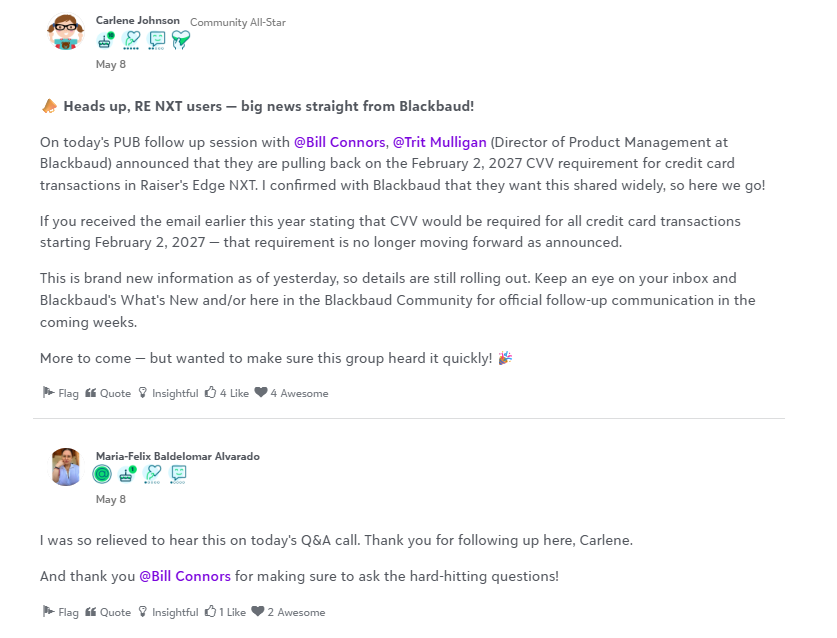
I followed this up with our customer success manager and was given the below link to keep update on this topic:
'You’ll see the latest updates will be updated here: What are the CVV or CSC requirements for Raiser's Edge NXT back office transactions?'
I've subsequently responded as I feel the guidance is still a little 'off track' with regarding what is compliance for PCI and for card issuers, please see below for my response and suggested course of action, I'm really happy to receive feedback/comments on this approach as I believe it to be correct but very much want to learn if I have misinterpreted guidance along the way:
Thank you for sharing the updated guidance.
Having now reviewed the article in full, I remain concerned about the way the guidance characterises ‘PCI-compliant collection of CVV for manual transaction entry’.
The wording throughout the article appears to imply that collecting CVV through manual or postal workflows is fundamentally acceptable from a PCI/card-brand perspective provided organisations implement suitable internal controls. For example:
‘Many customers have active solicitations and campaigns in the market and may not have internal processes in place to support PCI-compliant collection of CVV for manual transaction entry’.
My concern is that this frames the issue primarily as an operational/process gap, rather than acknowledging the underlying compliance concern with collecting CVV via persistent written channels in the first place.
While PCI DSS permits CVV use for card-not-present authorisation, Visa also classifies CVV2 as sensitive authentication data which must not be stored. In a postal donation workflow, the CVV is necessarily written down, transported, handled, and temporarily retained before destruction. That creates an exposure scenario fundamentally different from a telephone MOTO transaction where the value can be entered directly at the point of collection.
As written, the article could reasonably be interpreted by customers as confirmation that collecting CVV on mailed forms is broadly recognised as PCI compliant if appropriate internal procedures exist. I do not believe the current wording adequately reflects the nuance, differing card-brand interpretations, or the practical compliance concerns many organisations and assessors would have with that approach.
The recommendation to use QR codes or follow-up phone calls appears to recognise that collecting CVV on mailed forms presents additional security and compliance risks.
I’d appreciate it if you could pass this feedback on to the relevant compliance, product, and engineering teams, as I think some clearer wording around the distinction between telephone MOTO and postal workflows would be really helpful for customers trying to interpret the guidance correctly.
For transparency, I also intend to add these observations to the existing Blackbaud Community discussions on this topic (as linked in my original email below), as I think it would be helpful for customers to have a broader and more collaborative discussion around the practical compliance considerations here. PCI requirements and card-brand interpretations can be something of a minefield, and I think additional context and nuance would benefit organisations trying to navigate this area responsibly.
2






















Categories
- All Categories
- New YourCause Community TEST
- New SKY Community TEST
- New Grantmaking TEST Community
- New Altru Test Community
- New bbcon Community - TEST
- 12 Blackbaud Agents for Good™
- New Raiser's Edge NXT Community
- 7 Blackbaud Community Help
- 218 bbcon®
- 1.4K Blackbaud Altru®
- 409 Blackbaud Award Management™ and Blackbaud Stewardship Management™
- 1.2K Blackbaud CRM™ and Blackbaud Internet Solutions™
- 16 donorCentrics®
- 361 Blackbaud eTapestry®
- 2.7K Blackbaud Financial Edge NXT®
- 681 Blackbaud Grantmaking™
- 599 Blackbaud Education Management Solutions for Higher Education
- 3.3K Blackbaud Education Management Solutions for K-12 Schools
- 952 Blackbaud Luminate Online® and Blackbaud TeamRaiser®
- 85 JustGiving® from Blackbaud®
- 7K Blackbaud Raiser's Edge NXT®
- 3.9K SKY Developer
- 257 ResearchPoint™
- 123 Blackbaud Tuition Management™
- 165 Organizational Best Practices
- 247 Member Lounge (Just for Fun)
- 40 Blackbaud Community Challenges
- 37 PowerUp Challenges
- 3 (Closed) PowerUp Challenge: Grid View Batch
- 3 (Closed) PowerUp Challenge: Chat for Blackbaud AI
- 3 (Closed) PowerUp Challenge: Data Health
- 3 (Closed) Raiser's Edge NXT PowerUp Challenge: Product Update Briefing
- 3 (Closed) Raiser's Edge NXT PowerUp Challenge: Standard Reports+
- 3 (Closed) Raiser's Edge NXT PowerUp Challenge: Email Marketing
- 3 (Closed) Raiser's Edge NXT PowerUp Challenge: Gift Management
- 4 (Closed) Raiser's Edge NXT PowerUp Challenge: Event Management
- 3 (Closed) Raiser's Edge NXT PowerUp Challenge: Home Page
- 4 (Closed) Raiser's Edge NXT PowerUp Challenge: Standard Reports
- 4 (Closed) Raiser's Edge NXT PowerUp Challenge: Query
- 822 Community News
- 3.1K Jobs Board
- 57 Blackbaud SKY® Reporting Announcements
- 47 Blackbaud CRM Higher Ed Product Advisory Group (HE PAG)
- 19 Blackbaud CRM Product Advisory Group (BBCRM PAG)